
The Glossy Squad is helping save a rare cockatoo
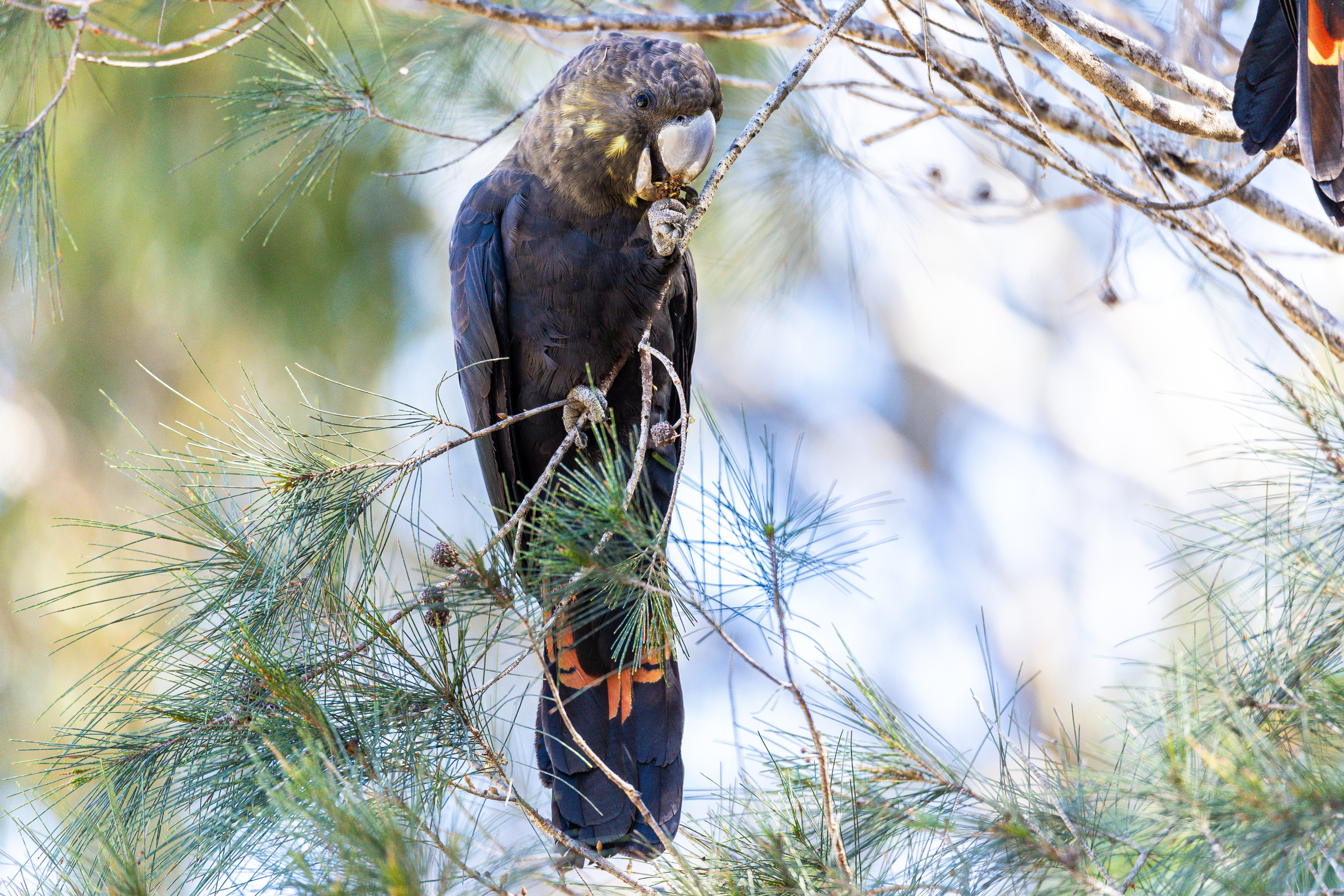
A lingering effect of the 2019 bushfires is their slow-burn impact on wildlife.
The green abundance as plants regenerate looks heartening, but nesting hollows for large birds can take more than a century to develop in a badly burnt landscape.
That’s why a NSW government conservation project is investigating how one of Australia’s most threatened cockatoo species is faring on the Mid North Coast.
Called Biliirrgan, the Gumbaynggir word for glossy black cockatoo, a key part of the project is the Glossy Squad, citizen scientists from the Nambucca, Bellingen, Coffs Harbour and Clarence districts.
Senior Threatened Species Officer Brian Hawkins said the volunteers spent over 1000 hours last year trying to spot where the birds were feeding, drinking and nesting.
Glossies are the only black cockatoo with red tails in northern NSW. Females have irregular yellow markings on their heads. They feed almost exclusively on she-oak seeds but will nest in any large tree with a suitable hollow.
Three breeding sites were found locally – in Kalang, Dundurrabin and Sawtell – and sound recording equipment established that a fledgling was successfully raised by the Kalang and Dundurrabin pairs.
The female glossy lays one egg in a vertical tree hollow and incubates it for a month. Her mate brings her food and water each day.
“He arrives and she comes out and he’ll give her a drink as well as a feed,” Dr Hawkins said. “Or sometimes he’ll come and sort of pick her up and they’ll go and have a drink together.”
Finding nest sites is crucial not only for establishing whether the birds are breeding successfully, but also because it means the area can be protected.
“Late last year, in the lead up to the fire season, we went and raked around that tree [in Kalang] so that if a fire came through, hopefully it wouldn’t reach the nest tree,” Dr Hawkins said.
About 10 glossies are under observation in the Promised Land and 20 regularly visit a particular puddle of water in Urunga, but no nesting sites have been found.
“We did so much monitoring of them [the Urunga birds] that we’re confident that they didn’t breed last year,” Dr Hawkins said. “We’ll be putting up some artificial hollows that have been specially designed for glossy blacks and 3D printed out of recycled plastic and fire-retardant material.”
Females have distinctive patterning on their heads, so another important part of the project is building up a photographic database identifying individual birds.
The plan is to then use specialised artificial intelligence software to match these mug shots to photos submitted by people in the field, to help track the birds’ movements.
To report sightings of glossy black cockatoos, go to the survey link https://arcg.is/14T50C
Published in the Bellinger Valley Herald, 5 May 2024

 Janene Carey